What Are the Emotional Support Animal (ESA) Laws in North Dakota?
Published
February 07, 2025
February 17, 2026

Medical Context Reviewed By:
Dr. Perry Payne
Perry W. Payne, Jr., MD, JD, MPP
Dr. Perry Payne
Attorney & Physician with expertise in health law and disability policy

Did you know that under North Dakota emotional support animal laws, your emotional support animal (ESA) cannot be denied housingn even in properties with strict ‘no pets’ policies? However, ESAs do not have universal access to public places.
Understanding emotional support animal laws in North Dakota ensures you and your companion are treated with fairness and respect. From housing accommodations to public access rights and workplace considerations, here’s everything you need to know about North Dakota ESA laws.
North Dakota ESA Housing Laws
Housing is one of the most significant areas where North Dakota ESA laws offer protection. Under the Fair Housing Act (FHA), landlords must provide reasonable accommodations for tenants with ESAs. However, not all properties are bound by these rules.
Housing Exemptions:
- Owner-occupied buildings with four or fewer units.
- Single-family homes rented without a real estate agent.
- Housing run by private organizations or clubs with membership requirements.
If your housing falls under these exemptions, discuss your needs with your landlord or explore ESA-friendly options.
Housing Protections Under FHA
- Landlords cannot charge pet fees or deposits for ESAs.
- Discrimination based on the animal’s breed, size, or weight is prohibited.
- Under N.D. Cent. Code § 47-16-07.5, , supporting documentation for a service or supporting animal must be issued by a licensed medical professional who is not operating solely to provide service or assistance animal certifications.
Public Access Rights for ESA in North Dakota
Unlike service animals, emotional support animals are not guaranteed access to most public places under the Americans with Disabilities Act (ADA). However, North North Dakota emotional support animal laws provide certain accommodations, and there are several ESA-friendly spaces across the state where you and your companion can enjoy outings.
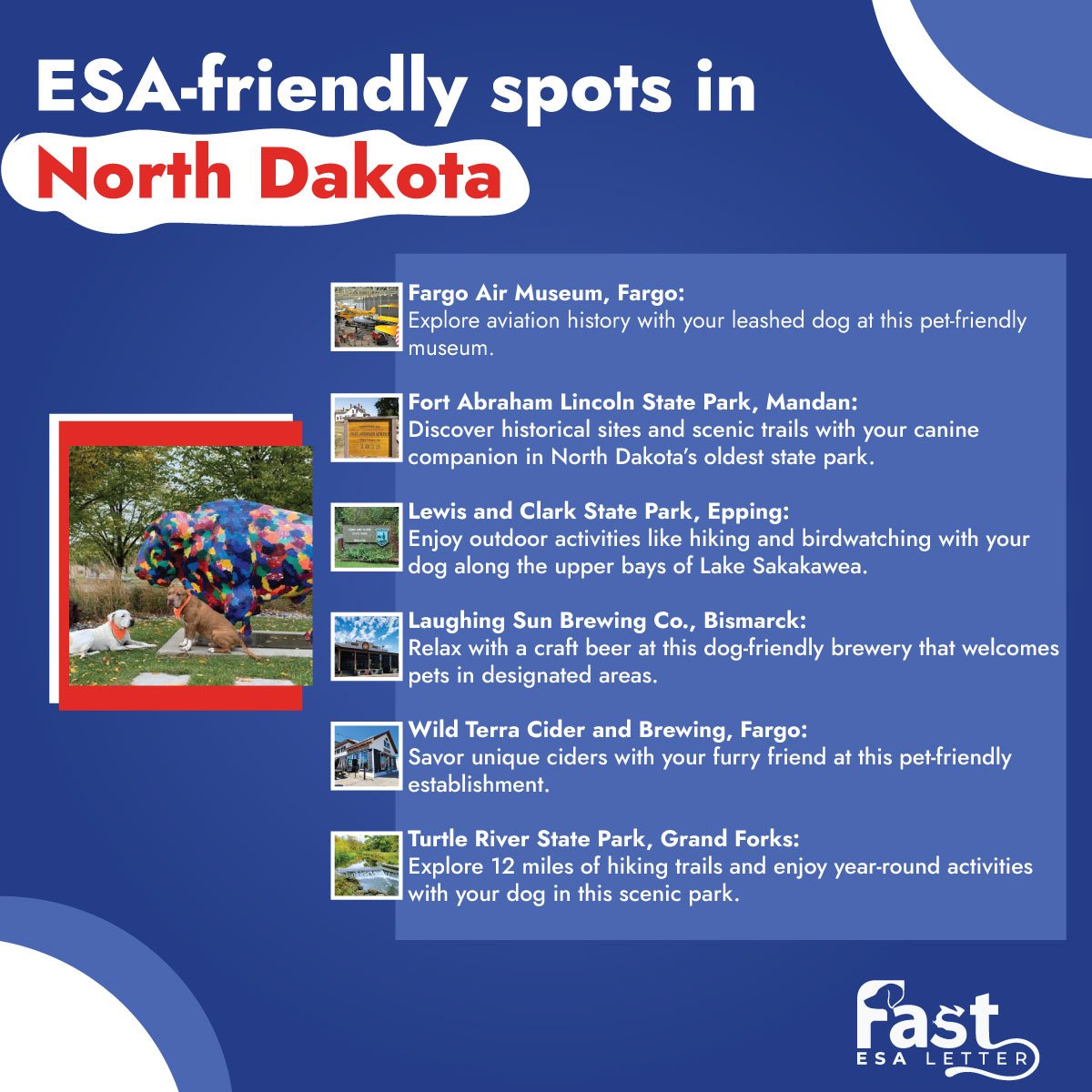
- Fargo Air Museum, Fargo: Explore aviation history with your leashed dog at this pet-friendly museum.
- Fort Abraham Lincoln State Park, Mandan: Discover historical sites and scenic trails with your canine companion in North Dakota’s oldest state park.
- Lewis and Clark State Park, Epping: Enjoy outdoor activities like hiking and birdwatching with your dog along the upper bays of Lake Sakakawea.
- Laughing Sun Brewing Co., Bismarck: Relax with a craft beer at this dog-friendly brewery that welcomes pets in designated areas.
- Wild Terra Cider and Brewing, Fargo: Savor unique ciders with your furry friend at this pet-friendly establishment.
- Turtle River State Park, Grand Forks: Explore 12 miles of hiking trails and enjoy year-round activities with your dog in this scenic park.
Travel Rights For ESA in North Dakota
Air Travel
Changes under the Air Carrier Access Act mean that emotional support animals are now treated as pets by airlines. ESAs:
- Must comply with pet fees and policies.
- Require prior approval from the airline.
- May be limited by size and breed restrictions.
Bus Travel
Train Travel
Amtrak allows pets on some routes, provided they comply with Amtrak’s pet policy, which requires that a pet be a small dog or cat weighing no more than 20 lbs (including the carrier). Moreover, pets must always remain in a closed carrier and stay with the owner throughout the journey.
Taxi and Ride-Sharing Services
In North Dakota, taxis and ride-sharing services like Uber and Lyft have different approaches to accommodating pets, including emotional support animals.
- For most taxis, it is the driver’s discretion whether pets, beyond one small animal such as a dog or a cat, are allowed in the vehicle.
- Lyft offers a “Pet ride” option in their app that guarantees a ride for up to four passengers and one well-behaved pet.
North Dakota ESA Laws For Workplace
Tips for Requesting Workplace Accommodations:
- Provide a detailed ESA letter outlining its role in your treatment plan.
- Engage in open communication with your employer about your needs.
- Propose reasonable accommodations, such as part-time ESA presence.
How to Qualify For an ESA in North Dakota?
Under the emotional support animal laws in North Dakota, qualifying for an ESA is a straightforward process that requires involvement from a physician or medical professional. It begins with discussing your mental health condition with a medical expert like primary care doctor or a psychiatrist, and having a legitimate therapeutic relationship to evaluate how an ESA could benefit your well-being.
If deemed necessary, the LMHP will provide an ESA letter in North Dakota that outlines your need for an emotional support animal. This letter serves as essential documentation for securing your ESA rights.

Penalties for ESA Fraud in North Dakota
Conclusion
Frequently Asked Questions
What Is The Difference Between A Service Animal And An Emotional Support Animal Under North Dakota Laws?
Can A Landlord In North Dakota Refuse My ESA Because Of Its Breed?
No, North Dakota ESA laws prohibit landlords from denying an ESA based on breed, size, or weight. However, the ESA must not pose a direct threat to the safety or health of others or cause significant property damage.
Do College Dormitories In North Dakota Have To Allow Emotional Support Animals?
Are Emotional Support Animals Allowed In Hotels In North Dakota?
Hotels are not classified as housing accommodations under the Fair Housing Act and are not required to accept ESAs. However, some pet-friendly hotels in North Dakota may accommodate ESAs—check individual policies before booking.
Can I Have More Than One ESA Under North Dakota Housing Laws?
Are Emotional Support Animals Allowed In Restaurants In North Dakota?
No, under North Dakota emotional support animal laws, ESAs do not have public access rights and are typically not allowed in restaurants unless they have pet-friendly policies. Check with the establishment before visiting.
Can A Landlord In North Dakota Ask For Details About My Mental Health Condition?
Does North Dakota Require Registration Of Emotional Support Animals?
No, North Dakota ESA laws do not require ESA registration. A valid ESA letter from a licensed mental health professional is the only documentation necessary to assert your rights under housing laws.
What Should I Do If A Landlord In North Dakota Refuses My ESA?
If your ESA is denied despite providing appropriate documentation, remind the landlord of their obligations under the Fair Housing Act and ESA laws North Dakota. If the issue persists, you can file a complaint with the Department of Housing and Urban Development (HUD).
Post Author

Prince Sharma
Related Articles

What Are the Emotional Support Animal Laws in Utah?
What Are the Emotional Support Animal Laws in Utah?In Utah, emotional support animals (ESAs) are protected under federal laws like the Fair Housing Act, which allows them in housing without pet fees, even in no-pet policies. However, ESAs are not...
What Are the Emotional Support Animal Laws in Kansas?
What Are the Emotional Support Animal Laws in Kansas?In Kansas, emotional support animals (ESAs) are protected under federal laws like the Fair Housing Act, which allows them in housing without pet fees, even in no-pet policies. However, ESAs are not...
What Are the Emotional Support Animal Laws in Nebraska?
What Are the Emotional Support Animal Laws in Nebraska?In Nebraska, emotional support animals (ESAs) are protected under federal laws like the Fair Housing Act, which allows them in housing without pet fees, even in no-pet policies. However, ESAs are...